Most small businesses make the same mistake when they start marketing.
They try to talk to everyone.
The website says things like:
“We help businesses grow.”
The Instagram bio says:
“Your trusted partner for success.”
The ads say:
“Get the best solutions for your business.”
Nothing is technically wrong with any of that.
But there’s a problem.
Nobody feels like you’re talking to them.
A salon owner, a SaaS founder, a local doctor, and an e-commerce brand can all be “business owners” — but they don't wake up with the same problem, the same budget, or the same reason to buy.
That’s where customer segmentation becomes useful.
And no, I’m not talking about creating a 40-page customer persona document with imaginary names, hobbies, and favourite coffee orders.
For a small business, segmentation can be much simpler.
It’s basically asking:
“Who are the different kinds of people buying from us, and why are they buying?”
Once you answer that honestly, your marketing starts making a lot more sense.
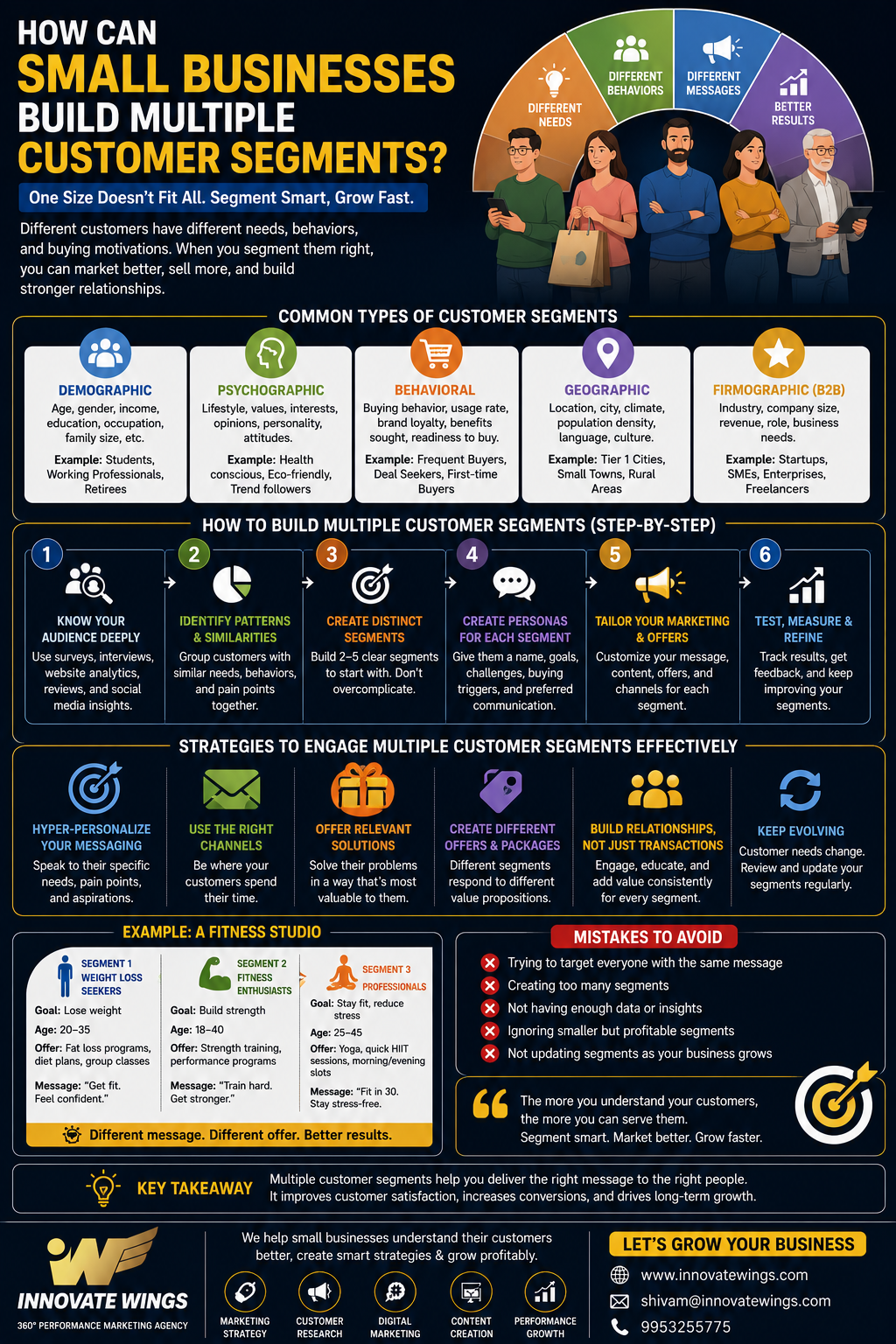
First, What Is a Customer Segment?
A customer segment is simply a group of customers who have something important in common.
It could be:
The problem they are trying to solve
Their budget
Their profession
Their location
Their buying behaviour
Their level of experience
What they care about most
For example, imagine you run a fitness business.
You might have one customer who wants to lose 10 kg.
Another wants to get stronger.
Another works 12-hour shifts and simply wants a workout routine they can actually stick to.
All three are buying fitness services.
But they aren't buying for the same reason.
And if your marketing says only:
“Join our fitness programme and transform your body.”
you’re making all three people do the work of figuring out whether your offer is right for them.
Good segmentation does the opposite.
It makes the customer think:
“Oh. This is exactly what I need.”
Why Trying to Sell to Everyone Usually Backfires
There’s a strange thing about marketing.
Businesses often believe that a broader message will attract more customers.
Usually, it just makes the message weaker.
Think about the difference between:
“We provide digital marketing services for businesses.”
and:
“We help local clinics generate more appointment enquiries through Google and Meta Ads.”
The second one immediately tells someone:
Who it's for
What problem it solves
How it helps
A clinic owner may ignore the first message.
They might stop at the second.
Not because the second agency is necessarily better.
It simply feels more relevant.
That is the power of segmentation.
You aren't necessarily changing what you sell.
You're changing how clearly people see themselves in your offer.
Start With Your Existing Customers
This is probably the easiest place to begin.
Don't start by inventing your “ideal customer.”
Look at the people who have already paid you.
That's where the useful information is.
Take your last 20–30 customers and look for patterns.
Ask:
What type of businesses are they?
Where are they located?
What did they buy?
Why did they contact you?
What problem were they trying to solve?
How much were they willing to spend?
Did they come back?
What did they complain about?
What did they appreciate?
How did they find you?
You may discover something interesting.
Perhaps your best customers aren't the customers you originally thought you wanted.
Maybe you thought you were targeting startups, but most of your profitable clients are actually established local businesses.
Or perhaps you thought customers cared about low prices, but your best customers repeatedly mention speed and reliability. That's useful information.
Your customers can tell you who your market is better than your assumptions can.
Look at Why People Buy
This is where segmentation gets more interesting.
Two people can buy the exact same service for completely different reasons.
Take website development.
One customer might say:
“I just need a website quickly. We're launching next month.”
Another might say:
“Our current website gets traffic but hardly any enquiries.”
Another might say:
“Our competitors look much more professional than we do.”
Technically, all three want a website.
But their actual problems are different.
So why would you put all three into the same marketing bucket?
You don't have to.
You could create different messages:
For the speed-focused customer
“Need your business website live before your launch?”
For the conversion-focused customer
“Getting traffic but not enough enquiries? Your website may be the problem.”
For the credibility-focused customer
“Does your website make your business look smaller than it really is?”
Same underlying service.
Completely different reason to care.
That's segmentation in practice.
Listen to the Words Customers Actually Use
This is one of the most underrated parts of marketing.
Pay attention to what customers say.
Not what you think they say.
Look through:
WhatsApp conversations
Emails
Sales calls
Reviews
Instagram comments
Customer complaints
Enquiry forms
Support conversations
Look for repeated phrases.
Maybe customers keep saying:
“I don't know where my leads are going.”
Or:
“We are spending money on ads but getting rubbish enquiries.”
Or:
“I don't have time to manage all this myself.”
Those sentences are far more useful than corporate marketing language.
You can turn them directly into marketing.
Instead of:
“Advanced lead-generation solutions for growing businesses.”
you might say:
“Getting leads but spending half your day chasing people who never respond?”
That sounds different.
Because it came from a real problem.
And real problems usually make better marketing than made-up marketing language.
Segment People by the Problem They Want Solved
This is often more useful than demographic segmentation.
Age and gender can matter.
But sometimes the bigger question is:
What is this person trying to fix?
For example, a digital marketing agency might have:
Segment 1: Businesses with no leads
Their biggest problem is visibility.
They need more people to discover them.
Their marketing should focus on:
Reach
Search visibility
Lead generation
Local SEO
Paid advertising
Segment 2: Businesses getting leads but not sales
Their problem isn't necessarily traffic.
It's conversion.
They may need:
Better landing pages
Stronger offers
Better follow-up
Sales process improvements
Lead qualification
Segment 3: Businesses dependent on referrals
They already get customers, but growth is inconsistent.
Their problem is predictability.
They may need:
Content
Search visibility
Paid acquisition
Retargeting
Email or WhatsApp nurturing
Same agency.
Same broad capability.
But completely different customer conversations.
Don't Ignore Budget
Money isn't everything, but pretending it doesn't matter isn't useful either.
A customer looking for a ₹5,000 service and a customer prepared to spend ₹5 lakh are not necessarily looking for the same
experience.
Their expectations may be different.
Their buying process may be different.
Their concerns may be different.
You might therefore have:
Entry-level offer
Growth package
Premium/custom solution
But there's an important warning here.
Don't create different packages just by adding more features.
Think about what each type of customer actually needs.
A small local business may need something simple and practical.
A growing company may need strategy, reporting, multiple channels and ongoing optimisation.
The segmentation should come from the customer's situation — not from your desire to create three shiny pricing cards.
Geography Can Create Very Different Customers
This matters particularly in India.
A business serving customers in Mumbai, Delhi, Jaipur, Lucknow, Indore and smaller Tier 2 or Tier 3 cities may find that the same offer doesn't work equally well everywhere.
The underlying need may be identical.
But:
Buying behaviour can differ.
Competition can differ.
Pricing expectations can differ.
Trust signals can differ.
Language and communication style can differ.
A local business may respond better to messaging around:
“Get more customers from your area.”
while a national e-commerce business may care more about:
“Increase online sales without increasing your acquisition cost.”
Again, you're not necessarily creating a new business.
You're simply making the message fit the situation.
You Don't Need a Different Brand for Every Segment
This is where businesses sometimes overcomplicate things.
They discover three customer groups and immediately think:
“We need three brands.”
No.
Please don't do that unless there's a very good reason.
Most small businesses can segment without creating separate brands.
You can use:
Different landing pages
One page for local businesses.
Another for e-commerce.
Another for B2B companies.
Different advertisements
Different hooks can speak to different problems.
Different offers
You might have a starter package for smaller businesses and a more comprehensive solution for companies that are further along.
Different email sequences
Someone who downloaded an SEO guide doesn't necessarily need the same emails as someone who requested a PPC consultation.
Different content
Create content around the actual questions and frustrations of each group.
You can keep one company while making the marketing feel much more personal.
A Simple Example: A Marketing Agency
Let's say you run a digital marketing agency.
Your current website says:
“We provide 360° digital marketing solutions to help businesses grow.”
Fine.
But now imagine you identify three important customer segments.
Segment A: Local businesses
They want:
More calls
More enquiries
Better Google visibility
Local customers
Your message could become:
“Get more enquiries from customers searching for your business locally.”
Segment B: E-commerce businesses
They care about:
Sales
ROAS
Cart abandonment
Conversion rate
Repeat purchases
Your message could become:
“Turn more of your paid traffic into profitable online sales.”
Segment C: Coaches and consultants
They may care about:
Personal branding
Authority
Consistent leads
Content
Consultation bookings
Their message could be:
“Build authority online and turn attention into qualified consultations.”
Same agency.
Same core marketing expertise.
But now each person has an obvious place to start.
That's much stronger than making everyone walk through the same generic message.
How Many Segments Should You Create?
Here's my advice:
Start with two or three.
That's it.
You don't need twelve.
If you create too many segments, you'll eventually spend more time managing the segments than serving customers.
A good segment should be large enough to matter and different enough to justify changing your message.
Ask:
“Would I genuinely communicate differently to these people?”
If the answer is no, they probably don't need to be separate segments.
Be Careful With Fake Customer Personas
This is another common marketing trap.
Someone creates:
“Meet Rahul, a 34-year-old entrepreneur from Delhi who enjoys coffee, cricket, podcasts and weekend travel…”
Okay.
But what are we supposed to do with that?
A persona is useful only when it helps you make a better marketing decision.
I'd rather know:
“Our best customers are founders who already spend ₹50,000+ per month on ads but don't have a reliable way of measuring
which campaigns generate actual sales.”
That's actionable.
You can build an offer around that.
You can write an ad around that.
You can create a landing page around that.
You can have a sales conversation around that.
Real behaviour beats imaginary personalities.
Let the Customer Tell You When Your Segmentation Is Working
There's a simple sign that you're getting this right.
People start saying:
“This is exactly what I'm dealing with.”
That's what you want.
Not:
“Interesting service.”
But:
“Wait… how did you know this was my problem?”
That difference is huge.
Because when people feel understood, the sales conversation becomes easier.
You don't have to spend the first 15 minutes explaining why the problem exists.
They already recognise it.
Don't Stop at Acquisition
Segmentation isn't only for getting new customers.
It can also help you keep existing ones.
Think about an e-commerce business.
Someone who purchased running shoes six months ago may be interested in:
Running socks
Insoles
Sportswear
New running shoes
Someone who bought a yoga mat may be interested in something completely different.
The business can use purchase history to make the next message more relevant.
That's much better than sending:
“BUY NOW! 20% OFF EVERYTHING!!!”
to everyone on the list.
Relevance doesn't always require sophisticated AI.
Sometimes it simply requires paying attention.
Segmentation Should Change as Your Business Changes
One thing founders often forget:
Your customer segments aren't permanent.
The customers you had two years ago may not be the customers you want today.
Your pricing may have changed.
Your product may have changed.
Your market may have changed.
Your most profitable customer may have changed.
So review your segments occasionally.
Ask:
Who is buying from us now?
Who is the most profitable?
Who stays the longest?
Who is easiest to serve?
Who gets the best results?
Who refers us?
Who do we actually want more of?
Sometimes the answer will surprise you.
And that's okay.
Good marketing isn't about sticking to an old customer profile forever.
It's about paying attention.
A Simple Customer Segmentation Exercise
If you want to do this today, don't open a complicated analytics dashboard.
Take a notebook.
Write down your last 20 customers.
Then create five columns:
| Customer | What they bought | Main problem | Why they chose you | What they cared about most |
|---|---|---|---|---|
| Customer 1 | Service A | Low leads | Referral | Results |
| Customer 2 | Service B | Poor website | Speed | |
| Customer 3 | Service A | High ad costs | Recommendation | ROI |
Do this for 20 customers.
Then look for patterns.
You may notice three or four groups naturally appearing.
Those are probably your first segments.
Then ask one final question:
“Would I sell to these groups differently?”
If yes, you've found something useful.
What Not to Do
Customer segmentation can help a lot.
But there are a few traps.
Don't create segments just because they look interesting.
If there's no meaningful difference in buying behaviour or needs, don't split them.
Don't create 20 customer groups.
You'll make your marketing impossible to manage.
Don't rely entirely on demographics.
“Women aged 25–35” tells you very little by itself.
The problem they're trying to solve tells you much more.
Don't change everything at once.
Start with your website messaging or one campaign.
See what happens.
Then improve it.
Don't assume your first segmentation is perfect.
It's a starting point.
Customer behaviour will teach you the rest.
The Real Reason Segmentation Works
At the end of the day, customer segmentation isn't really about dividing people into boxes.
It's about paying attention.
People have different reasons for buying.
They have different fears.
Different priorities.
Different budgets.
Different expectations.
And when your marketing acknowledges that, it stops sounding like a broadcast.
It starts sounding like a conversation.
That's the part many businesses miss.
You don't need to become a huge company with 50 different brands and complicated customer databases.
You can start with something much simpler:
Know who you're talking to. Know what they're trying to solve. Then talk about that problem in their language.
That's often enough to make a generic marketing message feel completely different.
How Innovate Wings Can Help
At Innovate Wings, we work with small and growing businesses that often have a good product but a very broad message.
The problem isn't always the marketing channel.
Sometimes it's the fact that the same message is being shown to completely different people.
We help businesses look at their existing customers, identify meaningful segments, sharpen their positioning, and build campaigns around what each audience actually cares about.
The goal isn't to make marketing complicated.
It's to make it more relevant.
If your business is currently trying to speak to everyone and your marketing feels scattered.
We'll take a quick look and share a few practical observations — no complicated presentation, no pressure, no sales pitch.
We boost sales and build a strong lead funnel with digital growth strategies. Using platforms like Facebook, Instagram, LinkedIn & Google Ads to build recurring leads and sales.

