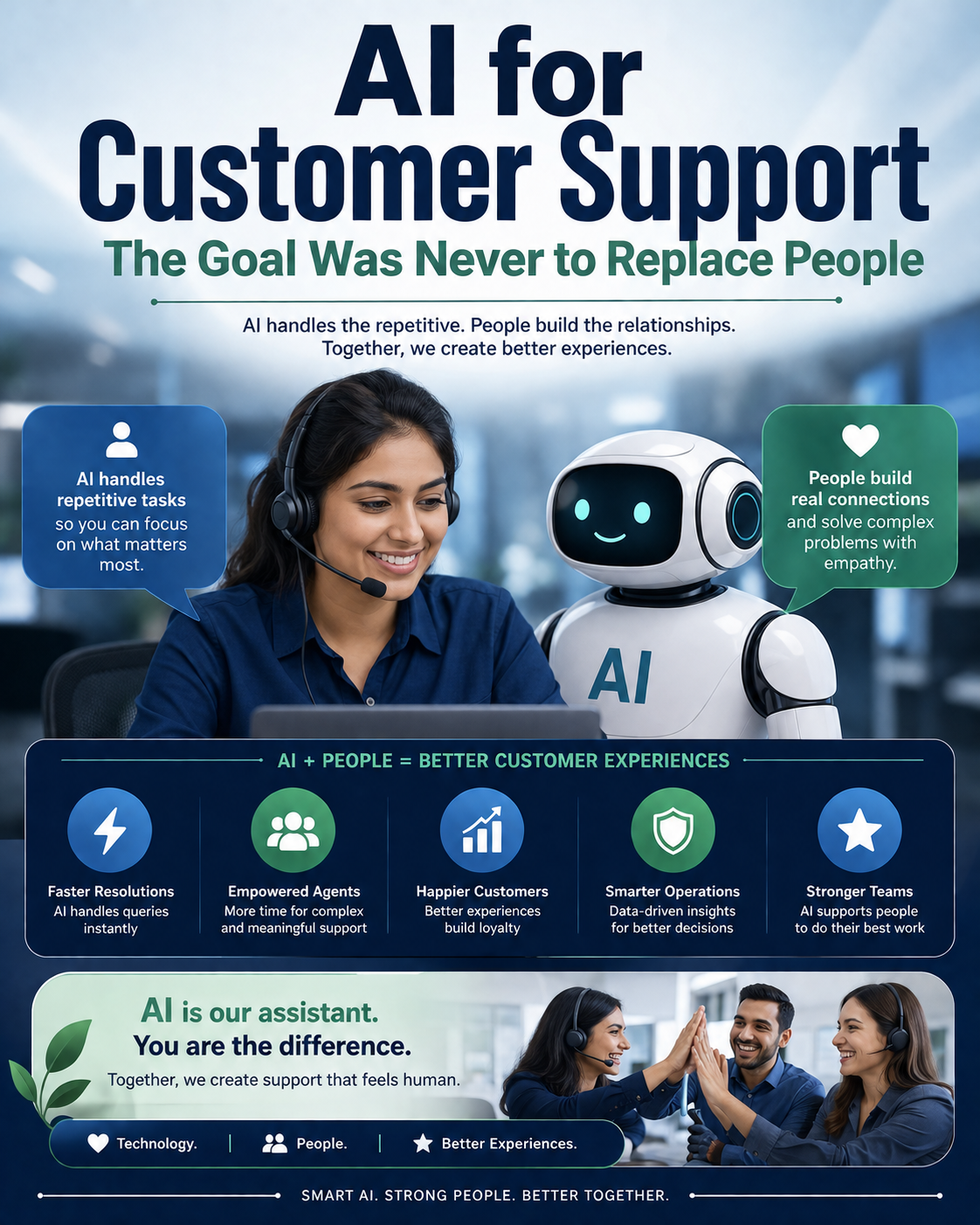
Every few months, there's a new headline saying AI is about to change customer support forever.
Most of those headlines make it sound like businesses won't need support teams anymore.
That hasn't been my experience.
If anything, AI has reminded me why good customer support still depends on people.
The biggest difference isn't that AI can have conversations. It's that it can take care of the work nobody enjoys doing in the first place.
Think about a normal day in customer support.
The first message asks where an order is.
The next one asks exactly the same thing.
Then someone wants to know the return policy.
Five minutes later, another customer asks for the return policy again.
By lunchtime, half the team has spent hours repeating information they could probably answer in their sleep.
That's not where people create value.
That's where they lose energy.
The best support teams aren't working harder anymore
I've noticed something interesting with businesses that use AI well.
Their teams don't suddenly become smaller.
They become calmer.
Instead of jumping between hundreds of repetitive conversations, they're dealing with the situations that actually need experience.
A delayed delivery.
A billing issue.
An upset customer.
A unique request that doesn't fit inside a help article.
Those conversations deserve a real person.
Everything else can often be handled much faster.
Speed matters—but only up to a point
Customers appreciate quick replies.
Nobody enjoys waiting six hours just to ask whether an item is back in stock.
But speed isn't what people remember.
They remember whether the business solved the problem.
A fast automated reply that sends someone in circles isn't helpful.
A clear answer that fixes the issue is.
Sometimes that's AI.
Sometimes it isn't.
The businesses getting this right know the difference.
One thing surprised me
I used to think customer support was mainly about answering questions.
Now I think it's one of the best ways to understand customers.
Support conversations reveal things analytics never will.
Where people get confused.
What they're nervous about before buying.
Which promises aren't clear.
What keeps frustrating existing customers.
Read enough conversations and patterns start appearing.
Those patterns usually point to a bigger business problem—not just a support problem.
Maybe your pricing isn't clear.
Maybe checkout is confusing.
Maybe customers keep expecting something your website never explains properly.
Fix that, and the support tickets often drop on their own.
AI is good at patterns.
People are good at people.
That's probably the simplest way to think about it.
AI can read thousands of conversations and tell you the questions that appear again and again.
It can organise tickets before anyone opens them.
It can suggest replies.
It can surface useful information in seconds.
But it doesn't understand disappointment the way a person does.
It doesn't know when someone simply needs reassurance instead of another perfectly written response.
That's still human work.
And honestly, I hope it stays that way.
Don't start with a giant AI project
Whenever business owners ask where to begin, I usually give the same answer.
Don't start with AI.
Start with frustration.
Ask your support team one question:
"What are you tired of answering every single day?"
The answers are almost always obvious.
That's where AI can help first.
Not because it's fashionable.
Because removing repetitive work gives people more time to do meaningful work.
The bigger lesson
Technology has changed customer support many times.
Email changed it.
Live chat changed it.
Messaging apps changed it.
AI is simply the next chapter.
The businesses that will benefit the most won't be the ones replacing every human conversation.
They'll be the ones protecting human conversations by removing everything that doesn't need one.
At Innovate Wings, that's how we look at AI.
Not as something that replaces people.
As something that gives people the time to be better at what only people can do.
Because customers rarely remember the software you used.
They remember how you treated them when they needed help.
We boost sales and build a strong lead funnel with digital growth strategies. Using platforms like Facebook, Instagram, LinkedIn & Google Ads to build recurring leads and sales.

