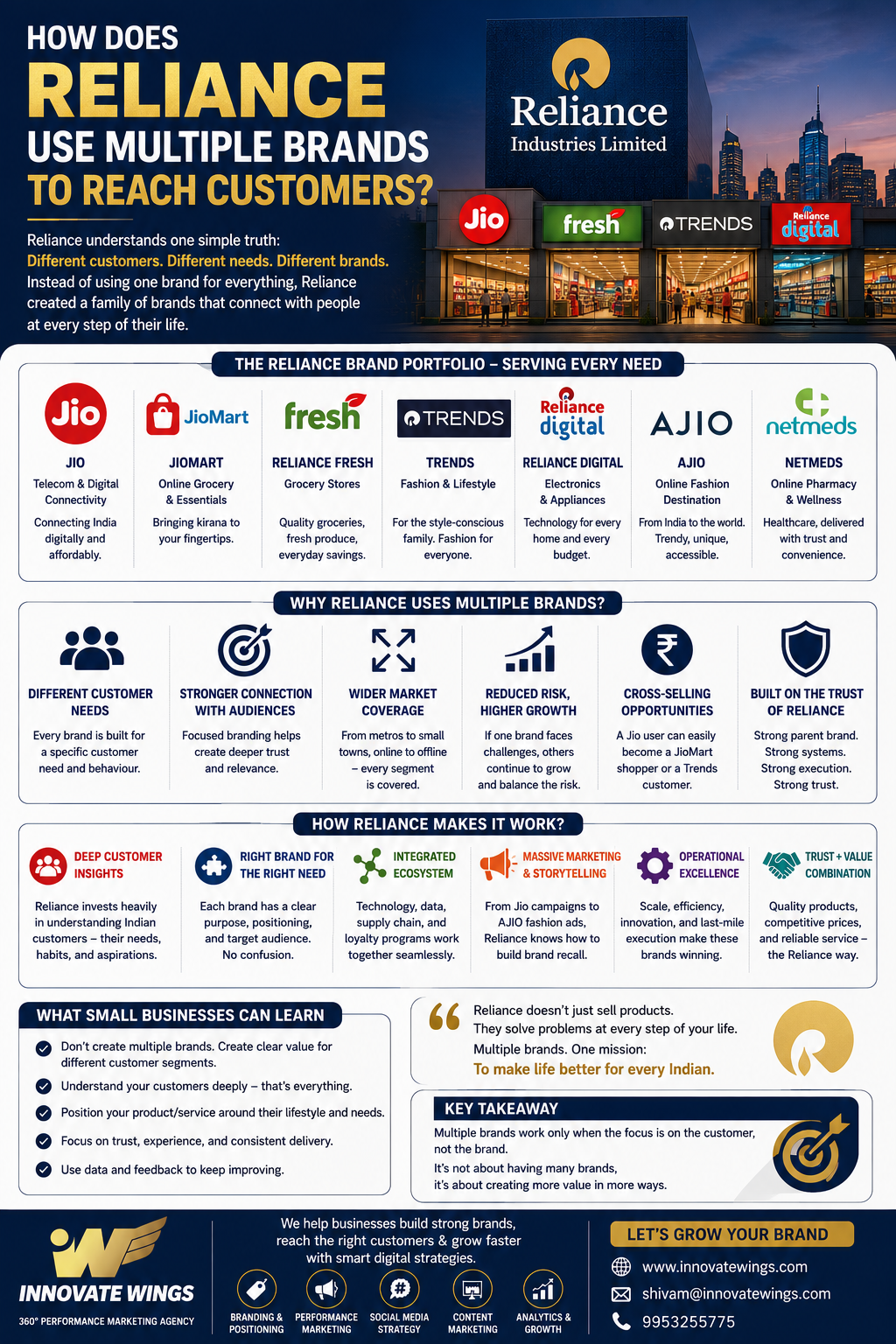

Walk into a Reliance Digital store and you’re thinking about electronics.
Open JioMart and you’re probably thinking about groceries or everyday shopping.
Go into Trends and the conversation is completely different — clothes, fashion, styles, prices.
Then there’s Reliance Jewels.
Same larger business group. Completely different customer mindset.
That’s what makes Reliance’s multi-brand strategy interesting.
It could have tried to put everything under one giant Reliance identity. Instead, it has built different brands for different categories, customers, occasions and price points.
And honestly, there’s a lesson here that small businesses can use — although probably not the lesson most people think.
The lesson isn’t: “Create five brands.”
Please don’t do that unless you have a very good reason.
The real lesson is about relevance.
A customer should feel like your offer was made for them, rather than like you’ve taken one generic message and shown it to everyone.
Why doesn’t Reliance put everything under one brand?
Think about the difference between buying groceries and buying jewellery.
You’re in two completely different mindsets.
When buying groceries, you might care about price, convenience, availability, delivery and everyday value.
When buying jewellery, the conversation changes. You may care about trust, design, occasion, quality, service and the overall buying experience.
Now imagine trying to market both with exactly the same brand voice.
It would be awkward.
That’s one reason having distinct brands can make sense.
Reliance operates brands such as JioMart, Reliance Smart, Trends, Reliance Digital and Reliance Jewels, each serving different categories and customer needs.
The customer doesn’t need to understand the entire corporate structure before buying something.
They just need to understand:
“Is this for me?”
That’s the job of positioning.
Different customers need different conversations
This sounds obvious, but businesses get it wrong all the time.
A company might sell to students, working professionals, business owners and large companies — and then use the same website headline for everyone.
Something like:
“We provide innovative solutions for all your business needs.”
Technically, it says something.
Practically, it says nothing.
The problem isn’t necessarily the service.
It’s the lack of relevance.
Reliance’s different brands allow it to build a more specific conversation around different categories and audiences.
That’s something even a small business can borrow.
You don’t necessarily need another brand.
You might just need different messaging for different customers.
For example, a digital marketing agency could have separate positioning for:
- Startups: “Get your first predictable lead engine running.”
- Real estate: “Turn property searches into qualified enquiries.”
- E-commerce: “Stop paying for traffic that doesn’t convert.”
Same agency.
Different problem.
Different conversation.
Much more relevant.
One brand doesn’t always have to mean one offer
This is where smaller businesses sometimes get confused.
They think:
“If I have one brand, everything has to look exactly the same.”
Not really.
Your core brand can remain consistent while your offers become much more specific.
For example, imagine a fitness business called FitLife.
Instead of creating three separate brands, it could have:
FitLife Weight Loss
FitLife Strength
FitLife for Busy Professionals
Same business.
Same reputation.
But each offer speaks to a different problem.
That’s often a much smarter first step than launching completely separate brands.
You get some of the benefit of segmentation without creating three websites, three social accounts, three content calendars and three headaches.
Different price points can create a positioning problem
Here’s where the multi-brand idea becomes particularly useful.
Imagine you build a premium service brand.
Everything about it says high quality, personal service, expertise and premium experience.
Then suddenly you start promoting:
“50% OFF! Cheapest in the market!”
You’ve created a problem.
The discount may generate sales.
But it also changes what people think your brand is worth.
Reliance operates across very different customer segments and categories. Separate brand identities can help prevent every offer from carrying exactly the same positioning signal.
For a small business, the answer doesn’t have to be a new company.
You might instead create a premium flagship service, a standard package and a starter package.
But be careful about how you present them.
Don’t make your premium service look like a discount product just because you’re trying to attract more enquiries.
Price is part of brand communication.
People notice what your pricing says about you.
The customer experience should match the promise
This is where branding gets real.
You can create the best positioning statement in the world.
But then the customer interacts with your business.
And that’s when they decide whether they believe you.
If your brand promises premium service but nobody answers the phone, the website looks unfinished, replies take three days, pricing is unclear, or staff don’t know what they’re selling — the positioning falls apart.
A brand isn’t what you write on the homepage.
It’s what happens after someone clicks “Contact Us.”
That’s why specialised brands can be useful.
A focused brand can build its product, communication and customer experience around one particular category.
Reliance Digital doesn’t need to behave like Reliance Jewels.
The customer is coming for a completely different reason.
And that’s the point.
The smarter small-business version is segmentation
This is probably the most useful takeaway.
Before creating another brand, ask:
Can I solve this problem with better segmentation?
Maybe you need separate landing pages.
Maybe you need separate service packages.
Maybe your website needs dedicated pages for different industries.
Maybe your ads should speak differently to different audiences.
Maybe your email list should be divided based on customer interest.
You can create relevance without creating an entirely new brand.
For example, a marketing agency might have one brand but separate pages for Marketing for Real Estate, Marketing for Healthcare, Marketing for SaaS and Marketing for E-commerce.
The brand remains the same.
The problem being discussed changes.
That’s often enough.
When should you actually consider creating a separate brand?
A separate brand might make sense when:
- The customer is completely different
- The price positioning is dramatically different
- The category is substantially different
- The existing brand would become confusing
- The business has enough resources to support it
If you don’t have the resources, don’t create another brand just because it sounds exciting.
What if you’re a small business with only one brand?
That’s completely fine. In fact, it may be better.
You can still use the thinking behind Reliance’s strategy.
Start by asking:
- Who are my best customers?
- Why do they choose us?
- What problem are they actually trying to solve?
- Are we talking about that problem clearly enough?
Those four questions can completely change your marketing.
The real lesson from Reliance
Reliance’s multi-brand approach shows that relevance matters.
Not every customer needs the same message.
Not every category needs the same experience.
Not every price point should communicate the same thing.
And not every business needs to force everything under one generic promise.
But there’s another side to that lesson.
Don’t confuse complexity with strategy.
Reliance can manage multiple brands because it has enormous resources and infrastructure behind the system.
A small business needs to be much more selective.
Sometimes the smartest strategy isn’t creating another brand.
It’s taking your existing brand and finally making it clear who it’s for, what it solves and why that customer should care.
That’s usually where the real growth starts.
Innovate Wings — your business growth strategy agency — helps small and growing businesses make that decision clearer — from positioning and segmentation to offer strategy, branding and digital marketing.
We boost sales and build a strong lead funnel with digital growth strategies. Using platforms like Facebook, Instagram, LinkedIn & Google Ads to build recurring leads and sales.

