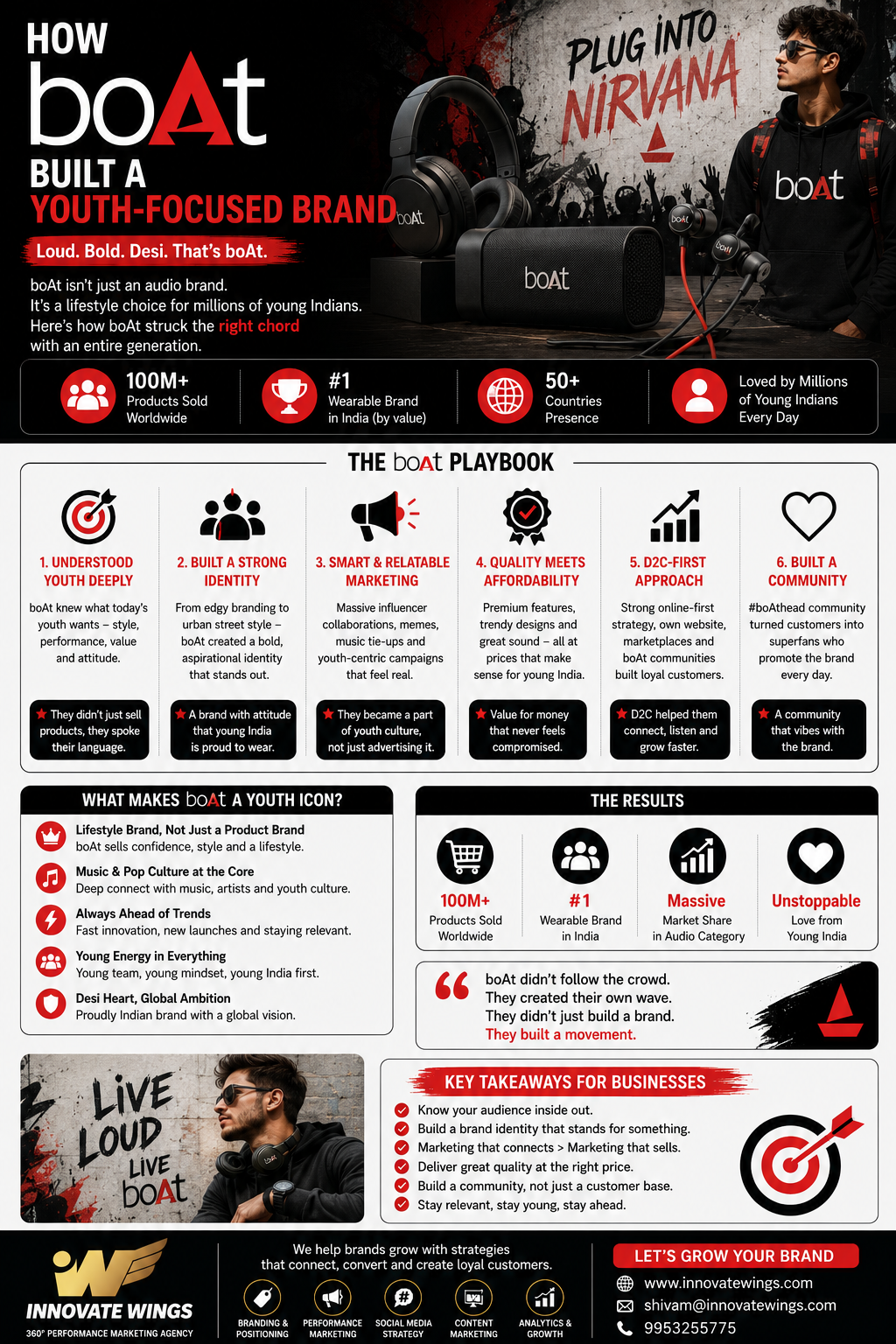

There was a time when buying earphones was a pretty boring decision.
You went to a shop, looked at a few models, checked the price, maybe asked the salesperson which one sounded better, and bought something.
That was about it.
Earphones were treated like electronics. Functional products. Something you needed for music, calls, travel, or watching videos.
Then boAt came along.
Suddenly, earphones started showing up in Instagram posts, cricket conversations, gym bags, college campuses, music playlists and influencer videos.
The product itself hadn’t suddenly become revolutionary.
What changed was the way people felt about the product.
boAt understood something that many consumer brands miss: young customers don’t always want to buy a product because of what it does.
Sometimes they want to buy what the product says about them.
That’s a much bigger marketing opportunity.
boAt built its identity around being young, energetic, stylish, accessible and connected to popular culture. Instead of behaving like another electronics company trying to explain technical specifications, it became a brand that wanted to be part of the lifestyle of its audience.
And that’s where the interesting lesson begins.
Because you don’t need to sell headphones to learn from boAt.
You can sell clothing, food, education, fitness programs, professional services, home products, beauty products, software or even something as ordinary as cleaning services.
The underlying question is the same:
How do you make a particular group of people feel that your brand was made for them?
That’s what boAt did remarkably well.
boAt Didn’t Try to Be Everything to Everyone
One of the first things that stands out about boAt is its focus on a particular kind of customer.
It wasn’t trying to create a product for every age group, every income level and every lifestyle.
The brand built strong connections with younger, digitally active Indian consumers who cared about music, entertainment, fashion, sports, gaming, fitness and technology.
That sounds obvious now.
But it matters.
Because when you know who you’re speaking to, your marketing decisions become easier.
Think about the difference.
A company selling earphones to “all consumers” might say:
High-quality audio products with advanced technology at competitive prices.
Nothing is technically wrong with that sentence.
But there’s nothing particularly interesting about it either.
Now imagine a brand speaking to a college student who listens to music on the way to class, watches YouTube at night, plays games with friends and follows cricket and fitness creators.
The communication can become much more energetic.
It can talk about music.
It can talk about workouts.
It can talk about gaming.
It can talk about travel.
It can talk about the culture surrounding the customer rather than constantly talking about the product.
That’s a major difference.
The lesson for smaller businesses
You don’t need to ask:
“How can I sell to more people?”
Sometimes the better question is:
“Who would absolutely love what I already sell?”
That’s where strong positioning usually starts.
A local café doesn’t necessarily need everyone in the city.
It might become the favourite café for college students.
A fitness coach doesn’t need every adult in the city.
They might become known for helping busy working professionals get fit.
A digital marketing agency doesn’t need to tell every company that it does everything.
It could become known for helping growing businesses fix poor lead generation.
Being specific doesn’t necessarily make your market smaller.
It can make your brand more meaningful to the people who matter most.
boAt Didn’t Just Sell Electronics
This is probably one of the most important parts of the story.
If you look only at what boAt sells, you miss what made the brand interesting.
Yes, it sells earphones, headphones, speakers, smartwatches and other electronic products.
But that’s not how the brand built its personality.
The communication often connected the products with things people already cared about:
Music.
Cricket.
Fitness.
Gaming.
Entertainment.
Fashion.
Creators.
Youth culture.
The product became a part of those conversations.
That’s a smart move because people don’t spend their entire day thinking about products.
They spend their day thinking about their lives.
What they’re listening to.
Where they’re going.
What they’re watching.
Who they’re following.
What they’re wearing.
What they’re trying to achieve.
What they’re sharing with friends.
A product becomes much easier to remember when it naturally fits into those things.
The Difference Between Selling a Product and Selling a Place in Someone’s Life
This is where a lot of smaller brands struggle.
They talk about themselves too much.
“We have been in business since…”
“Our product has these features…”
“We provide the highest quality…”
“Our services are affordable…”
“Our technology is advanced…”
But customers aren’t necessarily thinking about your company.
They’re thinking about their own problem.
That’s why the strongest brands often connect their products to a larger part of the customer’s life.
For boAt, audio products became connected with everyday youth culture.
For Nike, shoes became connected with sport, ambition and identity.
For Apple, technology became connected with creativity, design and personal expression.
The lesson isn’t to copy these brands.
The lesson is to ask:
What does my product mean in my customer’s life?
That’s a much more interesting marketing question.
It Made Affordable Products Feel Aspirational
Another smart part of boAt’s positioning was the balance between affordability and aspiration.
The products were accessible to a large audience.
But the brand didn’t want them to feel cheap.
That’s a subtle difference.
Cheap says:
“I’m inexpensive.”
Affordable aspiration says:
“I look and feel better than you’d expect at this price.”
That’s powerful.
A young customer may not have the budget for the most expensive international electronics brands.
But that doesn’t mean they don’t want something that looks good.
They still want a product they feel comfortable carrying.
They want something that fits their lifestyle.
They want something that looks current.
They want something that feels like a good purchase rather than a compromise.
boAt found space in that gap.
And that positioning helped the brand compete with established names without simply trying to become the cheapest option in the market.
This Is a Huge Lesson for Small Businesses
A lot of business owners assume that being affordable means offering discounts.
It doesn’t.
You can create perceived value in many ways.
Better design.
Better packaging.
Better photography.
Better communication.
Better customer experience.
Better presentation.
Better positioning.
Better service.
Better storytelling.
Imagine two businesses selling almost identical products.
Business A has poor product photos, a basic website, generic packaging and communication that looks like it was copied from ten competitors.
Business B has clean presentation, thoughtful packaging, clear messaging and a consistent personality.
The product may be almost identical.
But customers can perceive Business B as more valuable.
That’s why branding isn’t just decoration.
Perception influences purchasing decisions.
Design Wasn’t an Afterthought
boAt also understood something important about the category.
People don’t only hear earphones.
They wear them.
They carry them.
They put them on their desks.
They photograph them.
They show them to friends.
They see them in other people’s hands.
That means design becomes part of the marketing.
A product that looks distinctive can create recognition before someone even sees the logo.
Colours, shapes, packaging, naming and visual identity all contribute to that.
And this becomes even more important in a world where products appear constantly on social media.
Your product may be seen in an Instagram story, a YouTube video, a gym photo, a creator’s desk, a college student’s backpack, a cricket-related post or an unboxing video.
The customer may not consciously think:
“That’s excellent brand strategy.”
They simply recognise it.
“I’ve seen that before.”
That recognition is valuable.
Because familiarity makes brands easier to remember.
The Product Became Part of the Content
This is another important shift.
Traditional advertising starts with the advertisement.
The product is placed inside the advertisement.
But social media changed the game.
Now the product itself can become part of someone’s content.
Someone buys a pair of headphones.
They post a picture.
A creator reviews them.
A fitness influencer wears them during a workout.
A gamer uses them during a stream.
A musician talks about them.
A friend recommends them.
Suddenly the brand isn’t only communicating through its own advertising.
Other people are carrying the message.
That’s powerful because people often trust people more than advertisements.
boAt Understood the Power of Culture
The brand didn’t operate in a vacuum.
It showed up around things its audience already cared about.
Sports.
Music.
Entertainment.
Creators.
Gaming.
Fitness.
Social media.
This is important because marketing becomes easier when you’re not trying to manufacture attention from nothing.
You can borrow attention from existing communities.
If your audience already spends time watching cricket, you can create content around cricket.
If they follow fitness creators, collaborate with fitness creators.
If they care about gaming, speak to gamers.
If they follow musicians, build partnerships around music.
This doesn’t mean randomly attaching your logo to popular things.
It means finding a genuine connection between your product and the culture your customers participate in.
That’s the difference between relevance and opportunism.
Influencer Marketing Worked Because the Audience Was Already There
Influencer marketing is often misunderstood.
Many businesses think:
“Let’s find someone with one million followers.”
That’s not necessarily the best approach.
The real question is:
Does this person have the right audience?
boAt’s creator and celebrity partnerships worked in part because they connected the brand to people and communities its target audience already followed.
For a small business, the same principle can work on a much smaller scale.
You don’t necessarily need a celebrity.
A local business might work with a city-based creator, a fitness coach, a college creator, a niche YouTuber, a local food blogger, a professional in a specific industry, a community administrator or a micro-influencer with strong engagement.
Someone with 15,000 highly relevant followers can sometimes be more useful than someone with 500,000 completely unrelated followers.
Reach is useful.
Relevance is better.
### The Brand Didn’t Need to Sound Like a Corporate Brochure
This is something many traditional businesses can learn.
Look at the language used by many companies and you’ll see the same words again and again:
“Premium.”
“Quality.”
“Innovation.”
“Customer-centric.”
“Best-in-class.”
“World-class.”
“Cutting-edge.”
After a while, these words stop meaning much.
boAt’s personality was much more energetic.
It felt closer to the audience it wanted.
That matters because people notice when a company is trying too hard to sound like a company.
Especially younger audiences.
They don’t necessarily want a brand that talks down to them.
They want a brand that understands the culture they’re already living in.
Recognition Takes More Than One Campaign
Here’s another part that businesses often underestimate.
You don’t become memorable because of one great Instagram post.
You become memorable because people keep seeing you.
A brand appears in their feed.
Then they see it in a store.
Then a creator talks about it.
Then a friend owns one.
Then they see another advertisement.
Then they finally need the product.
By that point, the brand isn’t unfamiliar anymore.
That’s the power of repeated exposure.
And this is why consistency matters.
Businesses often get bored with their own message much faster than customers do.
The founder thinks:
“We’ve been talking about this for six months.”
The customer may think:
“I’ve only noticed you three times.”
That’s a very different perspective.
boAt’s Growth Also Shows Why Distribution Matters
A great brand is helpful.
But people also need to be able to buy the product.
boAt benefited from being present across digital commerce and retail environments, making it relatively easy for consumers to discover and purchase its products.
This is something small businesses sometimes overlook.
They spend months improving their Instagram page but make buying difficult.
Or they run ads but have a confusing checkout.
Or they create excellent content but don’t have enough availability.
Marketing brings attention.
Distribution turns attention into sales.
Both matter.
It Didn’t Stay Stuck in One Product Category
boAt started strongly in audio and later expanded into categories such as wearables and other connected consumer electronics.
There’s an important strategic idea here.
The brand wasn’t simply asking:
“What other product can we sell?”
A better question is:
“What other products might the same customer want?”
That’s a completely different way to think about expansion.
If your customer trusts you for one thing, you have earned the opportunity to solve another related problem.
But the connection needs to make sense.
A business shouldn’t expand just because a category is growing.
It should expand because there is a logical relationship between:
customer → existing problem → trust → next problem.
That’s how brands can grow without confusing people.
What Small Businesses Can Actually Learn From boAt
You don’t need a national advertising budget.
You don’t need celebrity endorsements.
You don’t need millions of followers.
You can still apply the thinking behind the strategy.
1. **Pick a real audience**
Don’t say “We serve everyone.” You probably don’t. Who are your best customers? What do they care about? Where do they spend time? Start there.
2. **Stop describing your product only by its features**
Features are important. But features alone rarely create emotional attachment. Translate features into real-life outcomes.
3. **Give your brand a personality**
Your brand doesn’t have to be loud. It can be funny, calm, bold, helpful, premium, friendly, straightforward or slightly rebellious. But it should feel like someone.
If every competitor could replace your logo with theirs and the content would still make sense, your personality isn't strong enough.
4. Find your customer's culture
Where do your customers spend their attention?
Instagram?
YouTube?
LinkedIn?
WhatsApp?
Reddit?
Local communities?
Sports?
Gaming?
Fitness?
Events?
Find the environment where your customers already gather.
Then become useful or interesting there.
Don't simply arrive with an advertisement.
5. Make the product worth talking about
Marketing cannot permanently rescue a bad experience.
Eventually, customers figure it out.
If you want word-of-mouth, give people something worth talking about.
It could be:
Better service.
Unexpected packaging.
Faster delivery.
A surprisingly good product.
A funny experience.
A thoughtful follow-up.
A memorable interaction.
People need a reason to tell someone else.
6. Don't confuse affordable with cheap
If you're competing only on price, somebody can always go lower.
Instead, create value.
Make the product look good.
Explain it properly.
Package it well.
Make the buying experience easy.
Support customers properly.
Build trust.
Then price becomes only one part of the decision.
7. Repeat your message
You don't need a new brand story every month.
Find the idea you want to own.
Then repeat it.
In your website.
In your ads.
In your social posts.
In your packaging.
In your sales conversations.
In your customer experience.
Eventually, people start connecting that idea with your name.
That's how memory is built.
8. Work with smaller creators
Don't automatically chase the biggest influencer.
Look for people whose audience actually resembles your customers.
A local creator with 20,000 engaged followers might drive more useful business than a celebrity with millions of followers.
The goal isn't to impress the internet.
The goal is to reach the right people.
9. Make your visual identity recognisable
Ask yourself:
If I removed the logo from my Instagram post, would someone still know it was mine?
If the answer is no, there's an opportunity.
Colours, photography, typography, product presentation and tone can all help create recognition.
You don't need something complicated.
You need something consistent.
10. Expand around your existing customer
Don't chase every opportunity.
Ask:
“What else does my customer need?”
That question can reveal better expansion opportunities than looking at random market trends.
A Simple boAt-Inspired Framework for Small Businesses
If I had to reduce the strategy into a simple framework, I'd look at five things.
Audience
Who exactly are you trying to become relevant to?
Identity
What should people feel when they encounter your brand?
Culture
What does your audience care about outside your product?
Experience
What makes buying from you better or different?
Repetition
What message are you willing to repeat until people remember it?
Get these five things right and you don't need to constantly chase the next marketing trend.
The Bigger Lesson Isn't About Earphones
This is probably the most important takeaway from the boAt story.
The company didn't simply find a way to sell more earphones.
It changed the context around the product.
Earphones became connected to identity.
Headphones became part of fashion and lifestyle.
Audio became connected with entertainment, fitness, gaming and youth culture.
And the brand became part of those conversations.
That's why this isn't really an electronics marketing lesson.
It's a brand-building lesson.
A business becomes stronger when people stop seeing it as just another company selling something.
They start recognising it.
Then remembering it.
Then preferring it.
Eventually, they may even recommend it without being asked.
That's the point where marketing becomes much easier.
You don't have to introduce yourself from zero every single time.
The customer already knows who you are.
What Would This Look Like for a Small Business?
Imagine you're running a local fitness studio.
You could say:
“We provide professional fitness training with experienced trainers and modern equipment.”
Or you could decide that your brand is:
“The fitness studio for busy professionals who want to get stronger without living in the gym.”
Suddenly, your marketing has somewhere to go.
Your content can talk about five-minute workouts.
Quick meals.
Desk-job stiffness.
Training before work.
Weekend fitness.
Real progress.
Busy schedules.
Your audience starts recognising the message.
You're no longer trying to speak to everyone who wants fitness.
You're speaking to a particular person.
That's what good positioning does.
And that's the deeper lesson behind boAt.
The Final Takeaway
boAt's success wasn't simply about selling affordable earphones.
The bigger achievement was making a fairly ordinary category feel relevant to a specific generation.
It understood its audience.
It built products around their preferences.
It connected those products with music, sport, entertainment, fashion and digital culture.
It made affordability feel aspirational.
It paid attention to design.
It used creators and cultural moments to stay visible.
And, perhaps most importantly, it stayed recognisable.
That's something a small business can absolutely learn from.
You don't need to become the next boAt.
You need to become the first choice in your own corner of the market.
Maybe that's a neighbourhood.
Maybe it's a city.
Maybe it's a particular profession.
Maybe it's a very specific customer group.
The goal isn't to make everyone notice you.
It's to make the right people remember you.
Because when someone finally needs what you sell, you don't want them searching through twenty similar businesses.
You want them thinking:
“I know exactly who to call.”
That's what a strong brand does.
How Innovate Wings Can Help
At Innovate Wings, we work with small and growing businesses that often have good products but struggle to communicate why people should choose them.
The problem isn't always advertising.
Sometimes the positioning isn't clear.
Sometimes the brand looks too similar to competitors.
Sometimes the business is talking about its services instead of the customer's actual problem.
And sometimes the marketing is reaching people, but giving them no reason to remember the brand.
Our approach is simple:
Understand the audience.
Clarify the positioning.
Build a recognisable brand.
Create marketing around real customer behaviour.
Then keep improving what works.
If your business feels generic, disconnected from its audience, or difficult to explain in one sentence, comment “BOAT” or send us your website or social media page.
We'll take a quick look and share a few practical observations.
No complicated presentation.
No buzzword-filled strategy deck.
Just an outside perspective on what could make your brand clearer and more relevant.
Innovate Wings — helping small and growing businesses become easier to notice, easier to understand, and harder to forget.
We boost sales and build a strong lead funnel with digital growth strategies. Using platforms like Facebook, Instagram, LinkedIn & Google Ads to build recurring leads and sales.

