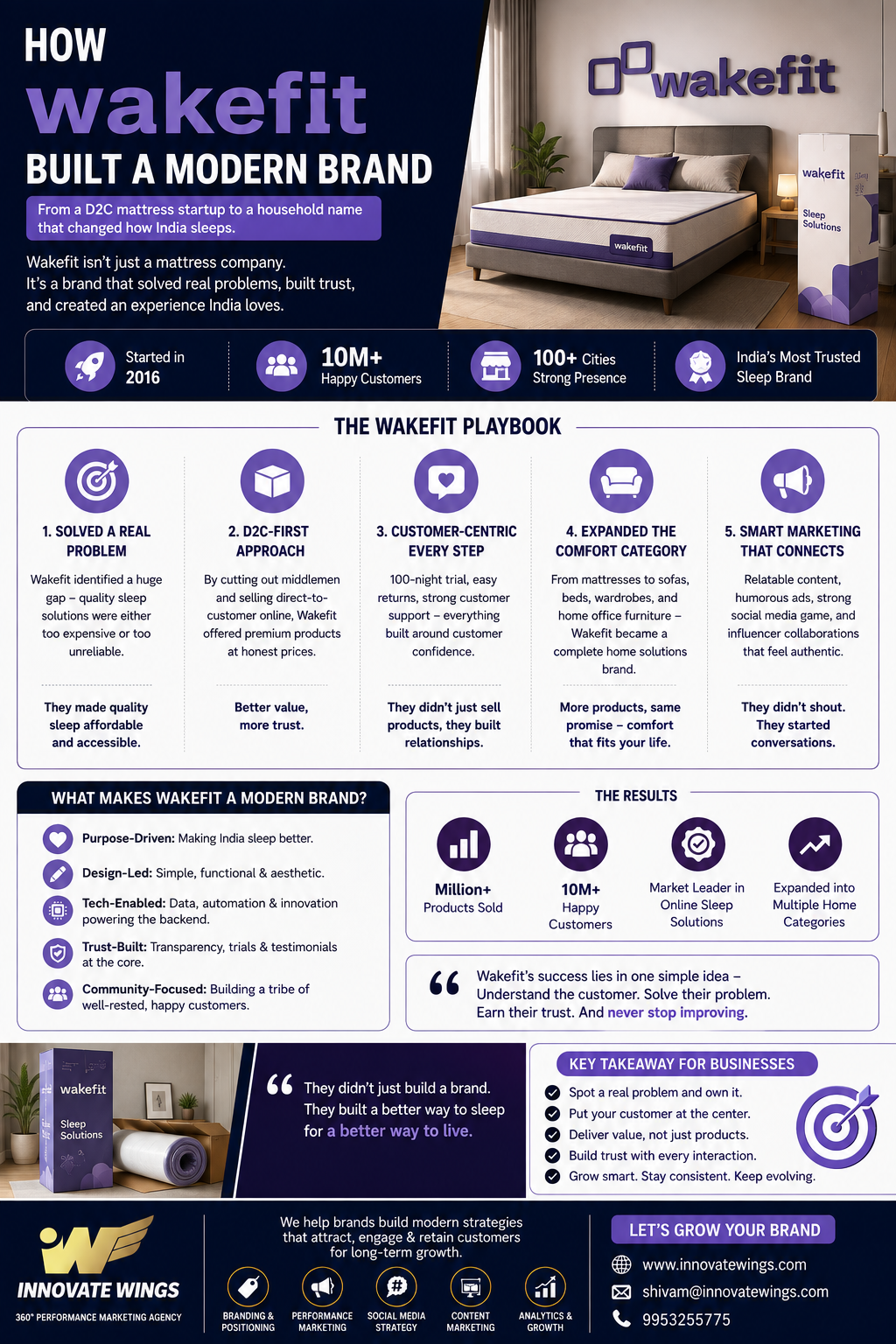
A mattress is not usually something people get excited about.
Most of us buy one only when the old one becomes uncomfortable, starts causing back pain, or has simply been used for too many years. We visit a shop, lie down on a few mattresses, ask about the price, negotiate a little, and choose one.
Then we go home and forget about the brand.
That was the usual experience.
Wakefit changed the way people looked at mattresses. Instead of talking only about foam, thickness, and materials, it started talking about sleep.
Better sleep. Better mornings. Fewer aches. More comfort.
That sounds simple, but it made a big difference. Sleep is something everyone understands. Once Wakefit connected its products to how people actually feel every day, the brand became much easier to relate to.
It focused on the problem people had
Most people do not wake up thinking, “I need a memory foam mattress.”
They wake up feeling tired.
They have a stiff neck. Their back hurts. They tossed and turned all night. They are looking for a solution, even if they do not know exactly what kind of mattress they need.
Wakefit understood that.
Instead of making the entire conversation about product specifications, it connected those features to a better night’s sleep.
That is a useful lesson for any business.
A digital marketing agency may offer SEO and paid advertising, but the customer is probably looking for more enquiries.
A café sells coffee, but the customer may really want a quiet break.
A financial advisor provides advice, but the client may be looking for peace of mind.
People do not always buy the thing you sell. They buy what they hope it will change.
It made mattresses part of everyday conversations
Let’s be honest. There is only so long people will listen to someone talk about foam density.
Wakefit made the subject more relatable.
Its content talked about oversleeping, weekend naps, working from bed, late alarms, and the struggle to feel rested. These were not complicated marketing ideas. They were situations people recognised from their own lives.
That was the clever part.
The brand did not always feel like it was trying to sell a mattress. It felt like it understood the way people lived.
The Sleep Internship campaign worked for the same reason. Paying people to sleep sounded so unusual that people naturally wanted to know more. At the same time, it was completely connected to Wakefit’s category.
That is what a good marketing idea does. It gives people something to talk about without losing the connection to the product.
Before publishing your next campaign, ask yourself:
Would people still find this interesting if our logo was not there?
If the answer is no, the idea may need more work.
It made online buying feel safer
Buying a mattress online can feel like a risk.
You cannot lie down on it before ordering. You cannot properly judge how firm or soft it will feel through a photograph. You are trusting the company to deliver what it promised.
Wakefit reduced some of that worry through trials, warranties, return policies, reviews, and clearer product information.
Those things may not be as exciting as a clever advertisement, but they help people make a decision.
Many businesses try to overcome hesitation by making bigger claims:
“We are the best.”
“We offer premium quality.”
“We are number one.”
But customers often need something more practical.
They want to know what happens if the product is not right. They want to know whether they can return it, how long it will last, and whether anyone will help them if there is a problem.
Trust is built by making the decision easier, not by repeating the same promise louder.
It listened to customer behaviour
Selling directly to customers gave Wakefit a closer look at what people were doing.
Which products were they viewing? What were they searching for? Where did they leave the website? What questions did they ask before buying?
These details can tell a business a lot.
Customers may say they are interested in a product, but their actions may reveal what is really stopping them. Perhaps the price is unclear. Perhaps the return policy is difficult to find. Perhaps the product page does not answer a basic question.
A small business can learn from this without buying expensive software.
Start with simple observations:
- Which pages do visitors spend time on?
- Where do people usually leave?
- What question do customers ask again and again?
- Which offer gets attention but not enough sales?
- What information do people need before they feel confident?
Sometimes the answers are more useful than another meeting about “new marketing ideas.”
Its expansion made sense
Wakefit began with mattresses and sleep products. Later, it moved into furniture, décor, storage, and other home products.
That did not feel completely random.
Someone who trusts Wakefit for a mattress may also consider it when buying a bed, table, sofa, or wardrobe. The company was still solving problems connected to the home.
That is a good way to think about expansion.
A tax consultant might add compliance services. A fitness coach might offer nutrition guidance. A website agency might provide maintenance and security support.
The best new service is often not something completely different. It is the next problem your customers are likely to face.
The idea matters more than the budget
A bigger budget can help more people see an advertisement.
It cannot make a boring message interesting.
Wakefit’s marketing stood out because the ideas were connected to real life and presented the category in a way people did not expect.
That is encouraging for smaller businesses. You may not be able to spend like a large brand, but you can still create something people notice.
Before increasing your advertising budget, ask:
- Is the message easy to understand?
- Does it connect to something customers care about?
- Does it sound like us?
- Is there anything memorable about it?
- Would someone share it with a friend?
Sometimes the problem is not a lack of money. It is that the message does not give people a reason to care.
Customers completed the story
Wakefit’s brand was not built through advertising alone.
Customers who had a good experience talked about it, left reviews, and recommended the brand to others. That kind of word-of-mouth gave the business credibility.
This is something many brands forget.
Marketing can get someone’s attention, but the actual experience decides what they say about you afterwards.
A funny post may bring someone to your website once.
A good product, reliable delivery, and helpful support can make them return and recommend you.
What small businesses can learn
You do not need Wakefit’s budget or team to apply the same principles.
You can start by:
- Talking about the customer’s problem before talking about your product.
- Using simple language instead of industry jargon.
- Creating content that people genuinely enjoy or find useful.
- Answering doubts before asking people to buy.
- Paying attention to what customers do, not only what they say.
- Developing a brand personality that feels natural.
- Expanding into services connected to your existing customer relationships.
- Improving the idea before spending more money promoting it.
These are not expensive changes.
They simply require you to pay closer attention.
The real lesson
Wakefit became memorable because it made an ordinary product feel relevant.
It talked about something people already cared about. It used humour without making the product irrelevant. It educated customers without sounding too technical. And it reduced the fear of buying online.
Most importantly, it understood people.
That is the part other businesses can copy.
You do not need to imitate Wakefit’s tone or create your own sleep campaign. You need to understand what your customers are going through and communicate in a way that feels honest and familiar.
People may forget the loudest advertisement.
They usually remember the business that made something easier, clearer, or better for them.
Innovate Wings helps small and growing businesses improve their positioning, content, and customer experience.
If your brand feels difficult to explain or your marketing sounds like everyone else’s,
We boost sales and build a strong lead funnel with digital growth strategies. Using platforms like Facebook, Instagram, LinkedIn & Google Ads to build recurring leads and sales.

