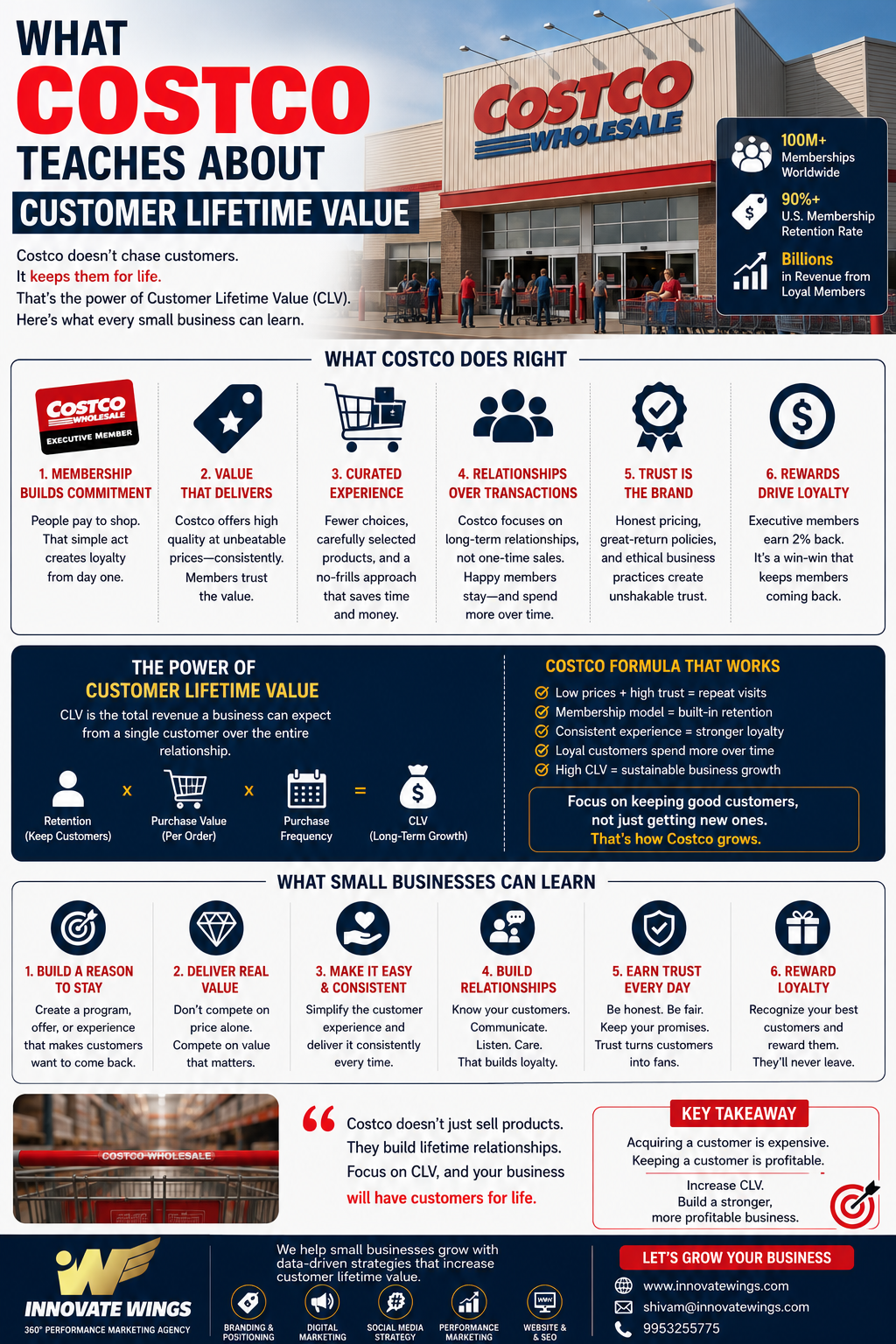

Most retailers chase the next transaction.
New offers.
New campaigns.
New customers.
Costco quietly does something different.
On the surface, it looks simple: giant warehouses, bulk products, low prices, loyal shoppers. But underneath, Costco is basically a customer lifetime value machine built on one core idea:
The real product is the membership. Everything else exists to make that membership worth renewing.
If you care about keeping customers — not just acquiring them — Costco is one of the clearest case studies out there.
Let’s break down what it’s actually doing and what smaller businesses can learn from it.
1. Loyalty starts with commitment, not points
Most loyalty programs look like this:
- Sign up for free
- Earn points slowly
- Redeem something small months later
Costco flipped that model.
You pay to become a member before you can buy anything in the warehouse. Gold Star membership (around 65 USD) gets you in; Executive (around 130 USD) gives you 2% cashback and extra perks.
That upfront payment changes the relationship:
- The customer is now invested.
- The brand is now responsible for making that investment feel worth it.
- Renewal becomes the key metric.
It’s loyalty as a business model, not a marketing campaign.
Takeaway:
Think beyond “collect points” loyalty. Where, if at all, can you create real commitment up front—a membership, a program, a retainer—where your success is tied to delivering ongoing value, not just pushing more one-off sales?
2. Membership fees fund lower prices (and more trust)
Costco sells products at razor-thin margins — often 8–14% instead of the 25–50% typical in retail.
They can do that because:
A huge chunk of operating profit comes from membership fees (over 5 billion USD a year and ~70%+ of operating profit).
- Merchandise margins don’t have to carry the business.
So when Costco cuts a price, it’s not a marketing gimmick. It’s structural. The model literally depends on making customers feel like they’re getting outstanding value for that annual fee.
That’s why renewal rates hover around 92–93%. Members don’t renew out of habit; they renew because the math and feeling both work.
Takeaway:
Customer lifetime value improves dramatically when:
- Your pricing feels fair and consistent.
- Customers clearly see how being loyal saves or benefits them over time.
Ask: **Does staying with you feel obviously better than starting over somewhere else?**
3. CLV is baked into the business, not bolted on
For many companies, “customer lifetime value” is a line in a marketing report.
For Costco, it’s the entire design:
Membership renewal is the core profit engine.
- Operational decisions (limited SKUs, bulk packaging, warehouse format) keep costs low and value high.
- The private label (Kirkland Signature) sells quality at great value, reinforcing trust and repeat buying.
- Generous return policies and transparent pricing further build long‑term trust.
Every part of the system is geared towards making it easy to keep coming back and hard to justify leaving.
Takeaway:
Don’t treat lifetime value as something you “optimize” later.
Design your offers, operations, and policies around one question:
“Does this decision make it more or less likely that a good customer will still be with us 3 years from now?”
4. They design for habit, not just purchase
Costco isn’t trying to win a random one-time shopping trip.
It’s building shopping habits:
- Bulk sizes fit monthly/weekly routines.
The “treasure hunt” experience (rotating special items) gives people something new to look for. Executive membership rewards ongoing high spending with cashback and perks.
Members don’t just visit; they *plan* around Costco.
The result: high-frequency, high-basket shoppers with extremely strong lifetime value.
Takeaway:
Ask yourself:
- Are you designed for habits or just occasional purchases?
- What would make customers naturally build you into their routine?
Examples:
- A service that runs on subscription/retainer instead of one-off jobs.
- A product with refill cycles and reminders built in.
- A membership that makes it cheaper or smarter to keep using you regularly.
5. Incentives are aligned with the customer
Costco’s profit structure forces it to care about member value:
- If members feel they’re not getting enough value, they don’t renew.
- If they don’t renew, the core profit engine breaks.
So:
- Costco keeps margins low.
Pays employees better than typical retail (leading to better service and retention). Keeps pricing straightforward.
- Avoids gimmicky promotions.
It wins only when the member feels like they’re winning.
That’s one of the strongest lifetime value lessons possible:
Loyalty works best when your profit depends on doing right by the customer.
Takeaway:
Look at your model honestly:
- Do you make more when customers are confused or locked in?
- Or when they’re satisfied and staying voluntarily?
The more you can structurally align your success with customer success, the more natural and durable your CLV becomes.
What small businesses can actually copy
You can’t build a Costco overnight.
You probably don’t have warehouses, global supply chains, or millions of members.
But you can steal the logic behind what they’re doing:
1. Turn loyalty into a product, not a side program
- A membership, club, or retainer where people actively choose to stay.
2. Make ongoing value painfully obvious
- Better pricing for members/regulars, clear perks, better access, or priority service.
3. Design for repeat behaviour
- Subscription, recurring services, refill cycles, or regular check-ins that fit customers’ routines.
4. Measure and protect renewal/retention
- Treat renewal like revenue. Watch it. Fix anything that makes good customers leave.
5. Align incentives with long-term relationships
- Make it easier and more profitable for you and the customer when they stay longer.
Customer lifetime value isn’t just a math formula. It’s a design decision.
Costco proves that when you build the model around renewal and trust, customers don’t just buy — they commit.
Where Innovate Wings Comes In
Innovate Wings helps businesses move away from “one more campaign” thinking and towards systems that:
- Increase customer lifetime value.
- Make loyalty feel like a natural choice.
- Use membership, subscriptions, and experience design to keep good customers longer.
If you’re seeing good customers leave faster than you’d like — or you’re curious whether a membership or loyalty structure could work for your business.
We boost sales and build a strong lead funnel with digital growth strategies. Using platforms like Facebook, Instagram, LinkedIn & Google Ads to build recurring leads and sales.

