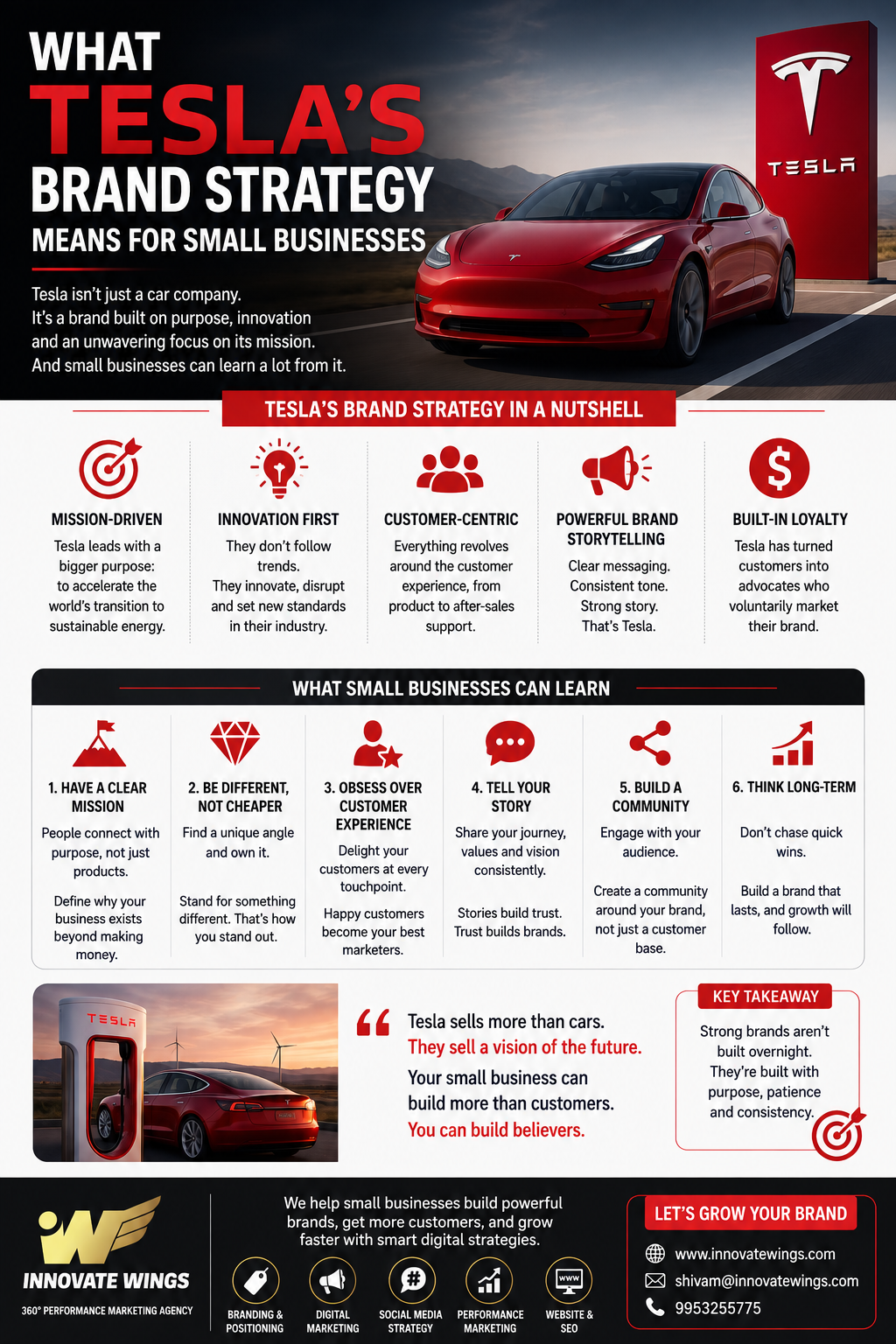

Tesla doesn’t behave like a normal car company.
No endless TV commercials.
No “Festival Offer – Limited Time Only” everywhere.
No giant showroom networks competing on discounts every weekend.
And yet, everyone knows the brand. People talk about it. Owning a Tesla feels like a statement.
That’s not an accident. It’s a brand strategy — and a lot of it is very relevant for small businesses that don’t have huge budgets.
Let’s break down a few things Tesla does differently and how you can steal the useful parts without pretending to be Tesla.
1. They stand for one strong, simple idea
Tesla isn’t positioned as “another nice car.”
It’s positioned as:
The company that makes electric cars exciting, high‑performance, and part of the future.
Tech product. Status symbol. Sustainability with speed. That’s the territory they own.
It’s clear. It’s focused. And it’s hard for competitors to copy because they didn’t take that position early enough.
Lesson for small businesses:
Stop trying to cram ten ideas into one brand.
If you’re “affordable + luxurious + premium + mass + innovative + traditional,” you’re nothing in particular.
Pick one clear idea people can attach to you:
- “The CA who explains tax without jargon.”
- “The cleaning service that always shows up on time.”
- “The bakery that only does two things — and both are incredible.”
Clarity beats cleverness. People remember simple, strong ideas.
2. They let the product and customers do most of the talking
Tesla spends very little on traditional ads compared to big automakers.
Instead, three things carry the brand:
- The cars themselves (distinct look, feel, and experience).
- The mission (sustainable energy, future-focused). - Owners talking about it (referrals, communities, fan content).
A parked Tesla in a neighbourhood is basically a billboard. Enthusiastic owners talk about their experience more powerfully than a scripted TV spot ever could.
Lesson:
If what you sell is genuinely good, lean into that.
- Make the experience so solid that people want to tell others.
- Make it easy and rewarding for them to refer friends (simple referral or thank‑you gestures).
- Listen to what happy customers say about you and use their language, not just your own.
Word‑of‑mouth is still one of the cheapest and strongest marketing channels. Tesla proves you can build a huge brand with very little paid media if your product and experience are strong enough.
3. They stay consistent for years
Tesla’s core story hasn’t changed much:
Sustainability. Performance. Technology. Future.
From the Roadster days to the Model 3 and beyond, the message is always some version of:
“We’re building the future of transportation and energy.”
Cars, solar, batteries, software — all plugged into that same mission.
Lesson:
If your brand message changes every few months, people can’t build a mental picture of you.
- Don’t switch from “premium” to “cheap” to “quirky” to “serious” based on trends.
- Choose a core idea and stick with it long enough for people to actually recognise it.
Consistency is boring from the inside.
From the outside, it’s exactly what makes you memorable.
4. They sell desire, not just utility
Tesla didn’t pitch electric cars as “good for the environment and practical for commuting.”
They made them feel:
- Fast
- Minimal
- Techy
- Aspirational
Owning a Tesla is about identity: “I’m early, I’m future‑minded, I care about tech and sustainability.
It’s desire, not just demand.
Lesson:
People rarely buy just features. They buy feelings and stories.
Ask yourself:
- What does buying from you say about the customer?
- What feeling do you consistently create — relief, pride, confidence, comfort, status?
Examples:
- A lawyer brand that makes people feel “protected and in control.”
- A local home service that makes people feel “looked after without drama.”
- A café that becomes “the cosy place where my day starts right.”
The more clearly you can name the feeling you create, the easier it is to build marketing around it.
5. They don’t join the price war
Tesla doesn’t lead with discounts and festival offers.
It positions itself as premium, and the pricing supports that. The value story is about innovation, future, status, and mission — not “best deal of the month.”
Lesson:
Competing only on price is a race to the bottom.
If your brand feels generic, you’ll keep dropping prices to win. If your brand feels distinct and strong, people are willing to pay more.
Branding gives you room to:
- Charge enough to do good work.
- Avoid constant discount pressure.
- Attract customers who value what you stand for, not just who’s cheapest today.
What small businesses can actually copy (without pretending to be Tesla)
You don’t need a global brand or a visionary billionaire founder. You need a sharper way of showing up.
Here’s a practical checklist:
1. Own one clear idea
- Decide what you want people to remember about you.
- Write it in one sentence.
- Use that sentence to guide your website, content, and sales pitch.
2. Make your product or service the marketing
- Fix the experience first.
- Make sure customers feel something worth talking about.
- Add a simple referral nudge (thank‑you notes, small perks, recognition).
3. Be consistent
- Stick with a core message and tone for at least a year.
- Stop rewriting your brand story every time you see a new trend.
4. Sell a feeling
- Stop describing only features.
- Talk about the outcome in human terms — “peace of mind,” “clarity,” “no more last‑minute panic,” “a home that actually feels clean.”
5. Don’t fight only on price
- Use brand strength — clarity, experience, story — to justify your pricing.
- Make sure your offer actually feels worth paying more for.
Strong branding isn’t about acting like a big company.
It’s about being clear, consistent, and worth remembering in your own market.
Innovate Wings — your business growth strategy agency — helps small businesses build brand strategies that:
- Make positioning clearer.
- Make the experience more memorable.
- Reduce the need to “shout” or discount all the time.
We boost sales and build a strong lead funnel with digital growth strategies. Using platforms like Facebook, Instagram, LinkedIn & Google Ads to build recurring leads and sales.

